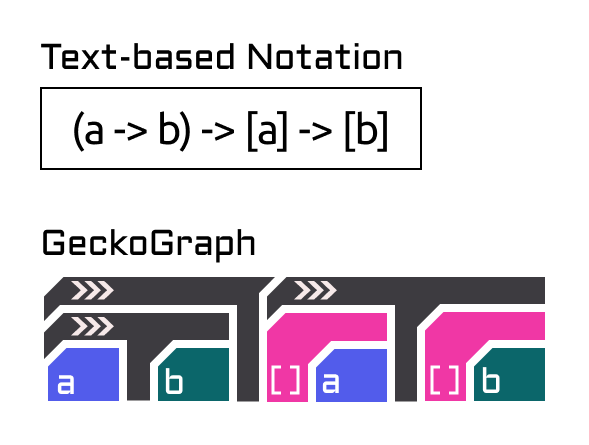
What is GeckoGraph?
GeckoGraph is a visual notation for type annotations in statically typed programming languages. It is intended to work tangibly with text-based annotations, but uses colors, shapes, and symbols to make structures of types easy to identify at a glance.
Why GeckoGraph?
Easy to learn
GeckoGraph should take little to no effort to learn. The rules to translate a text-based type notation to GeckoGraph should be minimal. Where possible, GeckoGraph should be intuitive to programmers who are familiar with text-based type notation.
Easy to parse by humans
GeckoGraph should make the task of reading and understanding type notation easy. It should emphasize the less obvious properties of a type signature. GeckoGraph should eliminate the need for mental backtracking, such as counting opening and closing parentheses and remembering which type classes are required on which variables.
Optimized for comparing and searching
GeckoGraph should aim to make the task of comparing two types easy, especially to make subtle differences in text-based notation harder to miss. This also includes the task of choosing an ideal function from a list of potential functions. For example, programmers search for a desired function from a documentation site with only partial knowledge of its type (e.g., the arity of a function, containing a known type, or type classes requirements).
Links